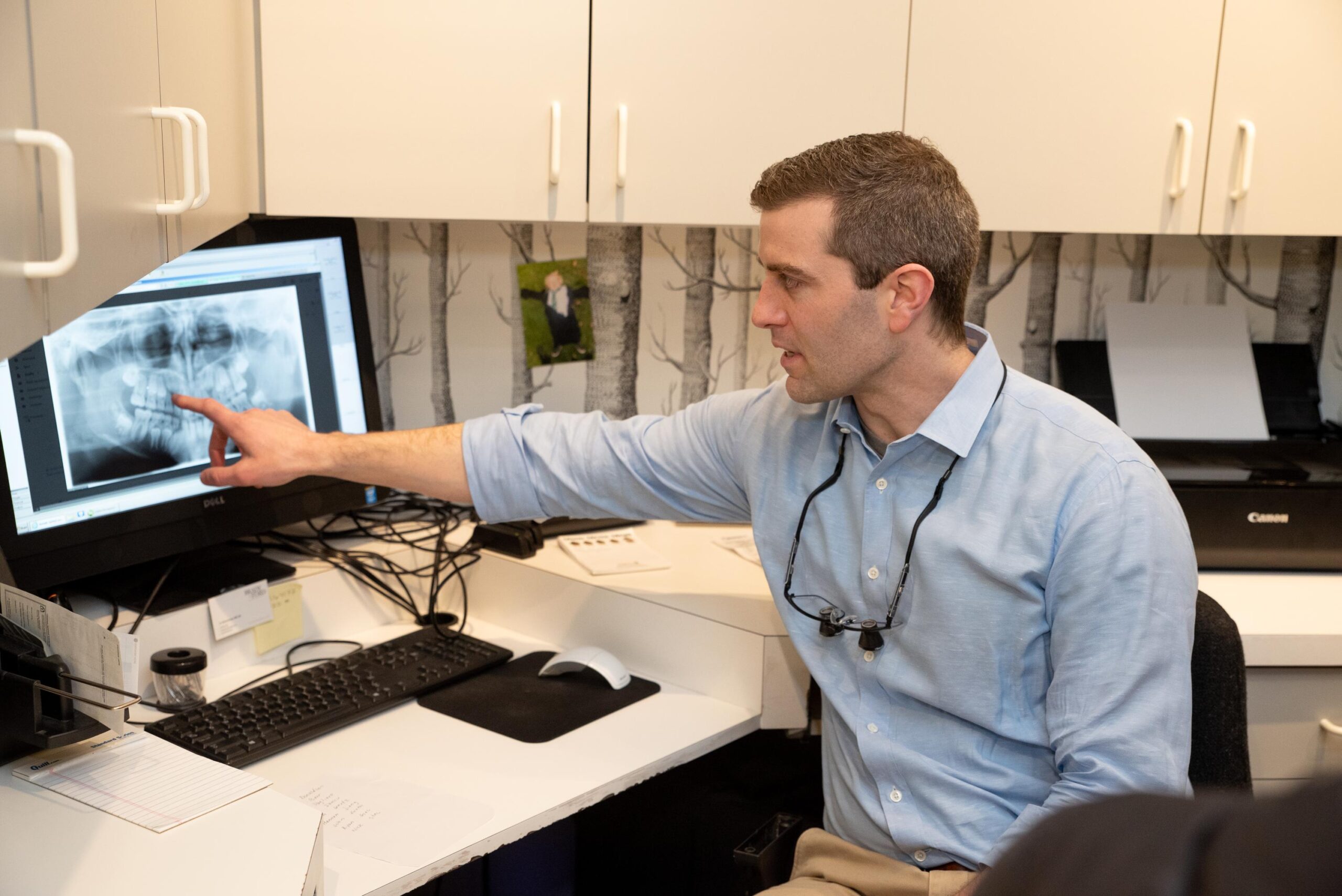
Most patients today do not need teeth pulled for braces. Modern orthodontics has moved away from routine extractions, using jaw expansion, advanced wire technology, and careful planning to straighten smiles while keeping natural teeth in place. Extractions are only considered when crowding is severe or facial balance truly calls for it.
So when might tooth extraction for braces still be recommended? A few specific situations:
- Severe crowding where the jaw simply can’t fit all the teeth
- Significant front-tooth protrusion that affects your profile
- Impacted teeth that can’t erupt on their own
- Baby teeth blocking permanent teeth from coming in properly
Removing a baby tooth to help a permanent tooth erupt is very different from pulling a permanent tooth to create space. At Brady Orthodontics, every recommendation is case-by-case. Dr. Brady reviews your exam findings, digital X-rays, and digital scans before suggesting any plan, so you’ll always know the reasoning behind the approach. This case-by-case philosophy means two patients with similar-looking smiles may end up with very different treatment paths, and that’s exactly the point of a personalized evaluation.

How Orthodontists Decide If Extractions Are Needed
The decision to remove teeth before braces is never made lightly. It starts with a thorough evaluation, not a hunch.
At your first free exam, Dr. Brady performs a full clinical evaluation paired with panoramic X-rays and 3D digital scans. These tools show tooth position, root angles, jaw structure, and any teeth hiding below the gumline. From there, several factors shape the plan.
Space analysis. Dr. Brady measures the total size of your teeth and compares it to the available room in your dental arches. When teeth are significantly larger than the space, that’s a key signal to weigh.
Facial profile and lip support. Front teeth influence how your lips rest and how your smile frames your face. Pulling teeth back too far can flatten the profile, while leaving severe protrusion untreated affects both looks and function.
Bite relationship. How the upper and lower teeth meet matters just as much as how straight they look. Overbites, underbites, and crossbites each change the extraction conversation in different ways.
Jaw growth potential. This is huge for kids and teens. A growing jaw can be guided with expansion and interceptive treatment, often avoiding extractions entirely. Adults have less flexibility because growth has already finished.
Special circumstances. Impacted teeth, severely protrusive front teeth, or teeth too damaged to save can all influence the plan.
Once everything is reviewed, you’ll see your full treatment plan laid out before any extraction is scheduled. Nothing happens without your clear understanding and consent, and you’re always welcome to ask questions along the way.
Common Reasons Teeth Are Pulled Before Braces
When extraction is recommended, there’s always a specific clinical reason behind it. Here are the most common situations where removing a tooth truly helps the outcome:
- Severe crowding. When the jaw cannot accommodate all permanent teeth, there’s physically no room to align them. Extracting select teeth creates the space needed for the rest to move into healthy positions.
- Protruding front teeth. If the front teeth stick out noticeably, moving them back may require space behind them. Extracting premolars (the teeth just behind the canines) gives those front teeth somewhere to go, improving both bite function and facial balance.
- Impacted teeth. Sometimes a tooth is stuck below the gumline, blocked by a neighboring tooth or positioned sideways. Removing the blocker allows the impacted tooth to come in correctly, or the impacted tooth itself may need to come out.
- Severe bite discrepancies. Serious overbites, underbites, and crossbites sometimes call for extraction to create the room necessary to reposition teeth and correct how the jaws meet.
- Damaged or non-restorable teeth. If a tooth has extensive decay, a cracked root, or other damage beyond repair, extraction becomes part of the overall plan rather than something to avoid.
- Baby teeth blocking permanent eruption. This is a very different situation from permanent tooth extraction. A stubborn baby tooth that won’t fall out can block the permanent tooth underneath. Removing it is simple and clears the path for natural eruption.
It’s worth repeating: these scenarios represent the minority of cases. Most children, teens, and adults complete their smile journey with every natural tooth intact.

Extraction vs. Non-Extraction Treatment Options
Thanks to state-of-the-art tools and techniques, orthodontists now have more ways than ever to create space without removing teeth. Here’s how the main approaches compare:
| Approach | Best For | Preserves All Teeth? |
|---|---|---|
| Palatal expander | Growing children/teens with narrow upper jaw | Yes |
| Interproximal reduction (IPR) | Mild crowding in adults or teens | Yes |
| Arch development | Mild to moderate crowding, non-growing patients | Yes |
| Clear aligners | Mild to moderate cases, lifestyle-driven choice | Usually yes |
| Modern braces (KLOwen) | Moderate to complex cases | Usually yes |
| Extraction-based treatment | Severe crowding or profile concerns | No |
Palatal expanders gently widen the upper jaw while bones are still developing, creating room for crowded teeth without removing any. They work beautifully in younger patients and often set the stage for a simpler second phase of treatment.
Interproximal reduction (IPR) removes a very small amount of enamel between teeth, roughly the thickness of a fingernail. It’s a routine, conservative step that can free up enough space to resolve mild crowding.
Arch development uses braces or aligners to gently round out and lengthen the dental arch, making room for teeth to align without extractions.
Clear aligners and modern KLOwen braces combine with these techniques to deliver straight results while keeping every tooth in place whenever possible.
Extraction-based treatment has real trade-offs. Cases typically take longer and the mechanics are more involved. But for severe crowding or significant profile concerns, extraction often delivers better long-term stability. The right path depends entirely on your individual anatomy and goals, which is why a careful evaluation matters so much.
Which Teeth Are Typically Extracted
When extractions are part of the plan, the teeth chosen aren’t random. Premolars (also called bicuspids) are extracted most often. They sit between the canines and molars, so removing them creates space exactly where it’s most useful for aligning the front teeth and correcting bite.
Wisdom teeth are a separate conversation. They’re sometimes removed to prevent future crowding or because they’re impacted, but that decision is usually handled independently of braces planning and often by an oral surgeon working with your general dentist.
Extractions can add to the overall treatment timeline. That’s one more reason to explore non-extraction options first whenever possible, and to make sure every recommendation is backed by a clear clinical rationale you can understand.
Who Is a Candidate for Extraction-Based Braces Treatment?
Not everyone with crowded teeth needs extractions. Here’s a general picture of who might and who probably won’t:
More likely candidates:
- Adults with severe crowding whose jaws have finished growing, leaving expansion off the table
- Patients with significant front-tooth protrusion that affects facial balance
- Those with impacted teeth that can’t erupt by any other means
- Patients with severe bite discrepancies requiring substantial repositioning
- Anyone with damaged or non-restorable teeth already needing removal
Less likely candidates:
- Children caught early, when interceptive treatment and expansion can prevent the need
- Teens with some remaining growth potential and moderate crowding
- Adults with mild to moderate crowding that responds well to IPR or arch development
- Patients whose main concern is cosmetic alignment rather than structural correction
Age plays a real role here. Early evaluation matters because it opens doors that close as the jaw matures. The American Association of Orthodontists recommends a first orthodontic visit by age 7, not because kids usually need braces that young, but because early assessment can prevent bigger issues later. A simple check-in at that age often reveals whether a child is on track or whether a small adjustment now could save a bigger intervention down the road.
Dr. Brady often works with families to catch these windows at the right time. If your child is approaching that age or shows signs of crowding, an early exam is one of the smartest moves you can make for their long-term smile health.

Frequently Asked Questions About Pulling Teeth for Braces
What teeth are usually extracted for braces?
Premolars, also called bicuspids, are the teeth most commonly extracted for braces. They sit between your canines and molars, and removing them creates space right where it’s most useful for aligning the front teeth and correcting the bite. Occasionally other teeth are chosen based on their condition or position.
Does pulling teeth for braces change your face?
When extractions are planned carefully, your facial profile is preserved or even improved. Dr. Brady evaluates lip support, profile balance, and bite relationships before recommending any extraction. The outdated concern about “sunken” faces comes from older approaches that over-retracted front teeth. Modern planning avoids that outcome by keeping the whole face in view, not just the teeth.
Can adults avoid extractions?
Sometimes, yes. Adults with mild to moderate crowding often have excellent non-extraction options like IPR, arch development, and clear aligners. However, because adult jaws have finished growing, expansion isn’t typically possible, so options are more limited than for children and teens. A thorough exam is the only way to know for sure.
Will gaps from extractions stay open?
No. One of the main purposes of braces after extractions is to close those spaces completely. Over the course of treatment, the surrounding teeth are gradually shifted into the extraction sites, leaving a fully aligned smile with no visible gaps.
Are wisdom teeth removed for braces?
Usually, wisdom tooth removal is a separate decision from braces planning. It’s generally handled by a general dentist or oral surgeon based on whether the wisdom teeth are impacted, decayed, or likely to cause future issues. Dr. Brady can discuss timing and coordination with your dental team if wisdom teeth come into play.
Is it uncomfortable to have teeth extracted for braces?
Extractions are performed with local anesthesia, so the area is fully numbed during the appointment. Most patients experience only mild soreness afterward, easily managed with over-the-counter medication and following your dentist’s care instructions. Healing is typically quick, and braces can usually begin shortly after.
Curious whether your smile actually calls for extractions? The best next step is a conversation with an orthodontist who will look at your unique anatomy and goals. Learning more about your options is always a good idea, and at Brady Orthodontics we’re happy to walk you through what a personalized plan might look like for you or your child. Getting started is easy, and you’ll leave with real answers about your dream smile.
Brady Orthodontics welcomes Northfield families and neighbors across the North Shore at our Winnetka and Evanston offices.